
Stargazing India's Astronomy Guide for November 2026's Sky
1. Welcome & November 2026 Night Sky Overview
Welcome, fellow sky watchers, students, and outdoor enthusiasts, to StarGazing India’s definitive field guide for November 2026. As pioneers of Indian astro-tourism since 1991, our mission at StarGazing India has always been to transform the night sky into an accessible, living classroom by combining rigorous astrophysics with outdoor field operations.
November represents a sublime atmospheric boundary across the Indian subcontinent: as the post-monsoon haze dissolves and humidity drops, the crisp, subtle constellations of late autumn yield to the brilliant, jewel-encrusted asterisms of incoming winter. Timed for early evening observation—around 8:00 PM in early November, shifting to 7:00 PM by late November—this window provides exceptional atmospheric stability before intense late-winter thermal inversions and northern plain ground fogs set in. Rendered for a standard latitude of 40° North, this guide and chart are fully applicable across India’s latitudes (suitable for 15° North or South of this parallel), from the high-altitude plateaus of Ladakh to the dark desert expanses of Kachchh and our dark-sky base at Madhya Pradesh's 6 Astro Villages.
November Overhead Sky Architecture
| Horizon / Sky Sector | Primary Visible Constellations & Asterisms | Notable Deep-Sky & Key Markers |
|---|---|---|
| Western Horizon | Cygnus (The Northern Cross), Aquila, Lyra | Setting Summer Milky Way, Altair, Vega, Deneb |
| Zenith (Overhead) | Pegasus, Andromeda | Great Square of Pegasus (Inverted), M31 Galaxy |
| Eastern Horizon | Taurus, Auriga, Perseus | Rising Winter Beacons: Hyades, Pleiades (M45), Capella |
| Celestial Highway (Ecliptic) | Aquarius, Pisces, Aries, Taurus | Planetary & Lunar Navigation Track |
Scanning across the celestial dome this month, the overhead sky near the zenith is anchored by Pegasus, the Winged Horse, flying upside down and framed by the expansive Great Square of Pegasus. Sweeping toward the western horizon, the distinct, elegant cross shape of Cygnus, the Swan (the Northern Cross), traces the glowing central lane of the summer Milky Way as it slowly sets. Along the celestial highway, the Ecliptic cuts across Aquarius, Pisces, Aries, and Taurus, marking the highway along which the Moon and planets navigate throughout the month.
The clear post-monsoon Indian skies combined with early evening darkness create ideal conditions for both naked-eye orientation and deep-sky exploration before late-winter cold sets in. This early dark window allows field observers and public stargazing groups to inspect high-altitude objects through minimal atmospheric airmass while enjoying maximum thermal comfort under the open sky.
2. How to Read the Sky Map & Master Sky Orientation
Mastering dome-to-plane projection and cardinal alignment is the foundational skill for any field astronomer before attempting deep-sky star hopping. Without proper chart orientation, translating a two-dimensional flat map into the overhead three-dimensional celestial vault leads directly to spatial disorientation in the field.
Map Projection Mechanics
| Feature | Chart Representation | Field Equivalency |
|---|---|---|
| Zenith | Center point of the circular map | The point directly overhead (90° altitude) |
| Horizon | Outer circular boundary of the chart | 360-degree ground-level horizon line (0° altitude) |
| Mid-Altitude | Halfway between map center and edge | Approximately 45° altitude above the horizon |
Field Orientation Protocol
- Determine Direction: Identify the cardinal direction you are physically facing using a compass or known field landmarks (North, South, East, West, NE, NW, SE, SW).
- Rotate the Map: Turn the physical chart around its center so that the compass direction printed on the map's bottom edge directly matches the cardinal direction you are facing.
- Overhead Projection Alignment: Lift the map above your head. The center of the map will align with your zenith, placing the mapped constellations in exact alignment with the stars shining in the night sky.
Finding the Anchor Star: Locating Polaris
To lock in your northern navigational grid, utilize the northern sky's primary pointer stars within Ursa Major:
- Locate Ursa Major (The Great Bear) and its famous seven-star asterism, The Big Dipper (or Plough).
- Identify the two outer bowl stars, Merak (β UMa) and Dubhe (α UMa), known as the "Pointers."
- Trace an imaginary straight line extending through Merak and Dubhe upward across the northern sky for approximately five times their visual separation until you hit Polaris (α UMi), the North Star. Polaris marks the North Celestial Pole (NCP) in Ursa Minor.
3. Major Constellations & Recognizable Star Patterns
Constellations are not merely ancient mythological figures; they are defined sky-mapping sectors and anchor patterns essential for systematic celestial navigation.
Major November Constellations at a Glance
| Constellation | Distinct Asterism / Pattern | Prominent Feature / Object Hosted |
|---|---|---|
| Pegasus | The Great Square | Inverted winged horse, marker star Enif (β Peg) |
| Cygnus | The Northern Cross | Glowing Milky Way lane, Deneb (α Cyg), Albireo |
| Taurus | Broad V-shape (Head of Bull) | Pleiades (M45), Hyades cluster, Aldebaran |
| Ursa Major & Minor | Big Dipper & Little Dipper | Pointers (Merak & Dubhe) pointing to Polaris (α UMi) |
| Andromeda | Long diverging star chain | Hosts the Andromeda Galaxy (M31) |
| Cassiopeia | Circumpolar "W" | Star-hopping gateway to Perseus & Andromeda |
| Auriga | Broad stellar pentagon | Anchored by golden luminary Capella (α Aur) |
| Aries & Pisces | The Ram / The Circlet | Trace the autumn path of the Ecliptic |
Comprehensive Survey of Mapped Constellations
- Pegasus (The Winged Horse): Positioned almost upside down overhead near the zenith, anchored by the Great Square formed by α, β, and γ Pegasi alongside α Andromedae (Alpheratz). The nose is marked by Enif (β Peg).
- Cygnus (The Swan / Northern Cross): Dominating the western sky along the Milky Way. Deneb (α Cyg) marks the tail, while Albireo (β Cyg) forms the head.
- Aquila (The Eagle): High in the west, anchored by the brilliant white star Altair (α Aql), flanked by Tarazed and Alshain.
- Taurus (The Bull): Rising in the east along the Ecliptic, featuring the open clusters Hyades and the Pleiades (M45).
- Ursa Major & Ursa Minor: Skimming the northern horizon; pointer stars lead directly to Polaris in Ursa Minor.
- Andromeda: Extends northeastward toward Perseus, hosting the Andromeda Galaxy (M31).
- Cassiopeia (The Queen): Classic "W"-shaped circumpolar constellation in the north-northeast.
- Auriga (The Charioteer): Prominent in the northeast, marked by a pentagon anchored by Capella (α Aur).
- Aries & Pisces: Mid-magnitude zodiacal constellations spanning the Ecliptic between Taurus and Aquarius.
- Cetus (The Sea Monster): Equatorial southern constellation hosting variable stars Mira (ο Cet) and Diphda (β Cet).
- Perseus (The Hero): Positioned between Cassiopeia and Taurus, hosting the eclipsing binary Algol (β Per) and the Double Cluster.
- Delphinus (The Dolphin): Compact diamond-and-tail asterism located east of Aquila.
- Lyra (The Lyre): High in west-northwest, centered on blue-white Vega (α Lyr) and hosting the Ring Nebula (M57).
- Cepheus (The King): House-shaped circumpolar group containing variable prototypes δ Cephei and μ Cephei.
- Aquarius & Capricornus: Low south-southwestern sky, housing the Saturn Nebula (NGC 7009), Helix Nebula (NGC 7293), and M2.
- Southern Observers' Group (Sculptor, Fornax, Grus, Piscis Austrinus): Low southern horizon targets featuring bright beacons Fomalhaut (α PsA), Alnair (α Gru), and galaxy NGC 253.
- Draco (The Dragon): Winding circumpolar dragon between the Dippers, anchored by Etamin (γ Dra) and Thuban (α Dra).
- Hercules: Sinking in the northwest, home to northern globular clusters M13 and M92.
- Sagittarius & Ophiuchus: Setting in the southwest during dusk; marked by the "Teapot" asterism and rich clusters M17 and M25.
- Additional Border Constellations: Serpens Cauda, Corona Borealis, Boötes, Camelopardalis, Lynx, Eridanus, and Triangulum complete the panoramic vault.
Field Star-Hopping Techniques
- The Pegasus-to-Andromeda Hop: Extend a diagonal line from Scheat through Alpheratz (α And) in the Great Square and slide two stars northeast along Andromeda's main chain to reach Mirach (β And). Turn 90 degrees northwest to μ Andromedae, then continue that same visual distance to land on the glowing core of M31.
- The Cassiopeia-to-Perseus Hop: Trace an imaginary vector through the deeper "V" of Cassiopeia’s "W" (γ and δ Cas) and extend it southeast toward Perseus. Halfway along this line lies the Double Cluster (NGC 869 & NGC 884).
4. Important Stars Visible to the Naked Eye
Bright guidepost stars act as stellar benchmarks for assessing atmospheric seeing, visual magnitude limits, and sky clarity under field conditions.
Primary Guidepost Stars Reference
| Star Name | Constellation | Bayer Designation | Apparent Mag | Distance | Key Characteristics & Astrophysical Notes |
|---|---|---|---|---|---|
| Vega | Lyra | α Lyr | 0.03 | 25.0 ly | 5th brightest star; photometric baseline standard |
| Capella | Auriga | α Aur | 0.08 | 42.0 ly | 6th brightest star; golden-yellow spectroscopic binary |
| Altair | Aquila | α Aql | 0.77 | 16.7 ly | Rapid rotator; "the flying eagle" |
| Aldebaran | Taurus | α Tau | 0.85 | 66.7 ly | Orange giant; foreground star to the Hyades cluster |
| Fomalhaut | Piscis Austrinus | α PsA | 1.16 | 25.0 ly | Solitary bright southern beacon; "the fish's mouth" |
| Deneb | Cygnus | α Cyg | 1.25 | 1400 ± 200 ly | Extremely luminous white supergiant; apex of Northern Cross |
| Polaris | Ursa Minor | α UMi | 1.98 | 433 ly | Current North Pole Star; mag 8 telescopic companion |
| Algol | Perseus | β Per | 2.1 – 3.4 | 93 ly | Prototype eclipsing binary; 2.867-day period |
| Mira | Cetus | ο Cet | 3.0 – 10.1 | 300 ly | Pulsating red giant prototype; 332-day long-period cycle |
Secondary Guidepost Stars Reference
| Star Name | Constellation | Bayer Designation | Apparent Mag | Navigational & Visual Significance |
|---|---|---|---|---|
| Alnair | Grus | α Gru | 1.7 | Subgiant star anchoring the southern Crane |
| Hamal | Aries | α Ari | 2.0 | Principal yellow-orange guide star of Aries |
| Diphda | Cetus | β Cet | 2.0 | Prominent orange giant anchoring southern Cetus |
| Nunki | Sagittarius | σ Sgr | 2.0 | Bright star marking the handle of the "Teapot" |
| Etamin | Draco | γ Dra | 2.2 | Orange giant marking the Dragon's eye |
| Mizar & Alcor | Ursa Major | ζ UMa | 2.2 / 4.0 | Famous naked-eye visual double at Dipper's handle bend |
| Enif | Pegasus | β Peg | 2.4 | Orange supergiant marking the nose of the winged horse |
| Thuban | Draco | α Dra | 3.6 | Historical North Pole Star during Egyptian Pyramid era (~2700 BCE) |
5. Naked-Eye Deep-Sky Objects
Observing naked-eye deep-sky targets provides a unique field thrill: capturing photons with the unaided eye that have traveled unimpeded across thousands to millions of light-years of interstellar space.
| Object Name | Catalog Designation | Constellation | Distance | Visual Morphology & Observing Notes |
|---|---|---|---|---|
| Andromeda Galaxy | M31 / NGC 224 | Andromeda | 2,500,000 ly | Faint, elongated grey oval smudge. Most distant object visible to unaided eye. |
| The Pleiades | M45 | Taurus | 399 ly | "The Seven Sisters." Sparkling compact open cluster of hot, luminous blue stars. |
| The Hyades | Collinder 50 | Taurus | 152 ly | Broad V-shaped cluster forming the face of the Bull, framed by Aldebaran. |
Field Visual Technique: Averted Vision
To resolve the extended structure of these faint targets, observers must utilize averted vision:
- The Physiology: The central fovea of the human eye contains dense cones optimized for daylight and color, but it is largely insensitive in low-light environments. The peripheral retina is packed with rods, which are exceptionally sensitive to low-contrast light and subtle movement.
- Execution: Rather than staring directly at M31 or the outer edges of the Pleiades, shift your gaze 10° to 15° to the side of the target while keeping your attention focused on it. Photons will hit the rod-rich periphery, causing faint galactic halos and gaseous structures to pop into view.
6. Binocular Celestial Targets
Handheld 7×50 or 10×50 binoculars are the ultimate wide-field scanning tools, providing approximately 50 times the light-gathering capacity of a dark-adapted 7mm pupil.
| Target Name | Constellation | Object Type | Distance | Visual Morphology in 7×50 / 10×50 Optics |
|---|---|---|---|---|
| M2 | Aquarius | Globular Cluster | 37,500 ly | Bright, fuzzy star-like ball with prominent central condensation. |
| η Aquilae | Aquila | Cepheid Variable | 1,200 ly | Bright variable star; visual mag cycles between 3.6 and 4.5 over 7.166 days. |
| M38 | Auriga | Open Star Cluster | 4,300 ly | Bright open cluster displaying a Greek letter "pi" (π) or cross shape. |
| M36 | Auriga | Open Star Cluster | 4,100 ly | Compact cluster roughly half the size of M38; rich Milky Way background. |
| M37 | Auriga | Open Star Cluster | 4,400 ly | The finest of the Auriga trio; presents a glowing, granular stellar dust cloud. |
| μ Cephei | Cepheus | Red Supergiant | 2,800 ly | "Herschel's Garnet Star"; extraordinary deep ruby-orange color (Mag 3.4–5.1). |
| δ Cephei | Cepheus | Cepheid Prototype | 880 ly | Prototype Cepheid variable (Mag 3.5–4.4 every 5.366 days); split from mag 6 companion. |
| χ Cygni | Cygnus | Pulsating Red Giant | 550 ly | Huge brightness fluctuations from mag 3.3 down to 14.2 over a 407-day period. |
| M39 | Cygnus | Open Star Cluster | 900 ly | Large, loose triangular cluster easily resolved against the Cygnus Milky Way. |
| ν Draconis | Draco | Double Star | 100 ly | Wide pair of matching 5th-magnitude white stars separated by 62". |
| M13 | Hercules | Globular Cluster | 23,000 ly | Premier northern globular cluster; compact glowing ball between η and ζ Her. |
| M92 | Hercules | Globular Cluster | 26,700 ly | Dense, bright core; slightly smaller and fainter than neighboring M13. |
| varepsilon Lyrae | Lyra | Multiple Star | 160 ly | The "Double Double"; binoculars easily resolve the wide primary pair (208"). |
| R Lyrae | Lyra | Semi-Regular Variable | 350 ly | Red giant fluctuating between magnitude 3.9 and 5.0 over 46 days. |
| IC 4665 | Ophiuchus | Open Star Cluster | 1,400 ly | Expansive, coarse cluster spanning >1°, ideal for low-power fields. |
| NGC 6633 | Ophiuchus | Open Star Cluster | 1,000 ly | Large, elongated cluster showing dozens of resolved stellar points. |
| M15 | Pegasus | Globular Cluster | 30,000 ly | Dense core; chart notes it as the only globular hosting a planetary nebula (Pease 1). |
| Double Cluster | Perseus | Twin Open Clusters | 7,300 ly | NGC 869 and NGC 884; brilliant side-by-side field of sparkling supergiant stars. |
| M25 | Sagittarius | Open Star Cluster | 1,900 ly | Expansive cluster situated 6° north of the "Teapot" asterism lid. |
| NGC 253 | Sculptor | Spiral Galaxy | 11,400,000 ly | Large, high-contrast, cigar-shaped silver streak under dark skies. |
| Mizar & Alcor | Ursa Major | Visual Double | 83 ly | Iconic naked-eye/binocular pair at the bend of the Big Dipper's handle. |
| Cr 399 | Vulpecula | Asterism | 218–1,140 ly | "The Coathanger"; distinct pattern formed by 6 crossbar stars and 4 hook stars. |
| M81 | Ursa Major | Spiral Galaxy | 12,000,000 ly | Bright, compact oval core seen near fainter companion galaxy M82. |
7. Telescopic & Deep-Sky Objects
Aperture-driven astronomy moves observation into a new dimension, resolving double-star splits down to seconds of arc, exposing stellar color contrasts, revealing planetary nebula shells, and uncovering the delicate spiral structure of distant galaxies.
Telescopic Targets by Class
| Target Name | Object Class | Constellation | Required Aperture | Observing Notes & Key Details |
|---|---|---|---|---|
| Albireo (β Cyg) | Double Star | Cygnus | Small (70mm+) | Topaz golden primary (mag 3.1) and emerald-blue companion (mag 5.1); 34.4" split. |
| Almach (γ And) | Double Star | Andromeda | Small (80mm+) | Orange primary (mag 2.3) and sapphire-blue companion (mag 5.0); 9.8" split. |
| γ Arietis | Double Star | Aries | Small (60mm+) | Twin blue-white stars of equal magnitude (4.8); 7.8" separation. |
| η Cassiopeiae | Binary Star | Cassiopeia | Small (80mm+) | Yellow primary (mag 3.4) and orange-red dwarf (mag 7.5); 12" separation; 480-yr orbit. |
| 61 Cygni | Binary Star | Cygnus | Small (70mm+) | First star with measured parallax (1838); twin orange dwarfs (mags 5.2 & 6.1); 28.4" split. |
| γ Delphini | Double Star | Delphinus | Small (70mm+) | Yellow and white components (mags 4.3 & 5.2); shares field with faint pair Struve 2725. |
| α Herculis | Double Star | Hercules | Medium (100mm+) | Variable orange-red primary (mag 3.1–3.9) and green-blue companion (mag 5.4); 4.7" split. |
| β Lyrae | Multiple / Var. | Lyra | Small (60mm+) | Eclipsing prototype (mag 3.3–4.3) with a mag 7.2 blue optical companion. |
| varepsilon Lyrae | Quadruple Star | Lyra | Small/Med (75mm+) | "Double Double"; requires 100× to split both pairs (varepsilon^1: 2.3", varepsilon^2: 2.4"). |
| M57 (Ring Nebula) | Planetary Nebula | Lyra | Small/Med (80mm+) | Famous smoke-ring shell of illuminated gas ejected by a dying central star; 4,100 ly. |
| NGC 7009 (Saturn Neb.) | Planetary Nebula | Aquarius | Medium (200mm+) | Compact pale-green disk with distinct lateral handle-like projections ("ansae"). |
| NGC 7293 (Helix Neb.) | Planetary Nebula | Aquarius | Med/Large + Low Mag | Giant low-surface-brightness ring (1/4° across); requires dark skies and OIII filter. |
| M27 (Dumbbell) | Planetary Nebula | Vulpecula | Small (80mm+) | Brightest autumn planetary nebula; distinct hourglass shape in rich field; 975 ly. |
| M1 (Crab Nebula) | Supernova Remnant | Taurus | Medium (100mm+) | Remnant of the 1054 CE historical supernova; oval gaseous smudge; 6,500 ly. |
| M17 (Swan/Omega Neb.) | Emission Nebula | Sagittarius | Small/Med (80mm+) | Glowing swan profile floating on dark lanes; embeds cluster NGC 6618; 4,900 ly. |
| M16 (Eagle Nebula) | Emission Nebula | Serpens | Medium (150mm+) | Expansive star-forming region harboring the famous dust "Pillars of Creation"; 8,150 ly. |
| M11 (Wild Duck) | Open Cluster | Scutum | Small (70mm+) | Dense swarm of hundreds of stars arranged in a compact, V-shaped flight formation. |
| M33 (Triangulum) | Spiral Galaxy | Triangulum | Med/Large + Low Mag | Face-on spiral in Local Group; low surface brightness requires pristine dark skies. |
| M82 (Cigar Galaxy) | Starburst Galaxy | Ursa Major | Small/Med (80mm+) | Edge-on profile bisected by violent dust eruptions; paired with nearby M81. |
| M51 (Whirlpool) | Spiral Galaxy | Canes Venatici | Medium (150mm+) | Face-on grand design spiral actively interacting with companion dwarf NGC 5195. |
| M35 | Open Cluster | Gemini | Small (70mm+) | Sprawling open cluster resolving into hundreds of stellar pinpricks. |
| M22 | Globular Cluster | Sagittarius | Small (80mm+) | One of the brightest, most spectacular globular clusters in the sky. |
Optical Physics: Focal Length vs. Light-Gathering Aperture
Target selection in visual astronomy is dictated by optical physics:
- Focal Length & Resolving Power: Splitting close double stars—such as γ Arietis (7.8") or Almach (9.8")—depends directly on optical focal length and resolving limit (Dawes' Limit: Resolution in arcseconds = 116 / Aperture in mm). High magnification compresses light into tight airy disks to separate close stellar cores.
- Aperture & Light Gathering: Expansive, low-surface-brightness targets—such as the Helix Nebula (NGC 7293), spanning nearly 1/4° (1500")—do not require narrow magnification. Instead, they demand large light-gathering aperture paired with short focal ratios (f/4 to f/6) and low magnification to collect diffuse photons without spreading them beyond visual detection thresholds.
8. Date-by-Date November Sky Calendar (Chronological IST Conversion)
All Universal Time (UT) coordinates have been systematically converted to Indian Standard Time (IST = UT + 5h 30m). Events crossing midnight roll over to the next calendar date.
| Universal Date & Time (UT) | Converted IST Date & Time | Primary Celestial Event | Observational Notes & Critical Visibility Windows |
|---|---|---|---|
| Nov 01 @ 20:29 UT | Nov 02 @ 01:59 AM IST | Last Quarter Moon | Excellent dark, moonless post-dusk observing window. |
| Nov 02 @ 14:00 UT | Nov 02 @ 07:30 PM IST | Moon near Mars (Mag 0.9) | Daylight alignment. Observe pre-dawn (04:30–05:30 AM IST). |
| Nov 02 @ 21:00 UT | Nov 03 @ 02:30 AM IST | Moon near Jupiter (Mag -2.0) | (Date Roll-Over) High and bright in pre-dawn sky. |
| Nov 03 @ 08:00 UT | Nov 03 @ 01:30 PM IST | Moon near Regulus | Daylight alignment. Observe pre-dawn on Nov 03. |
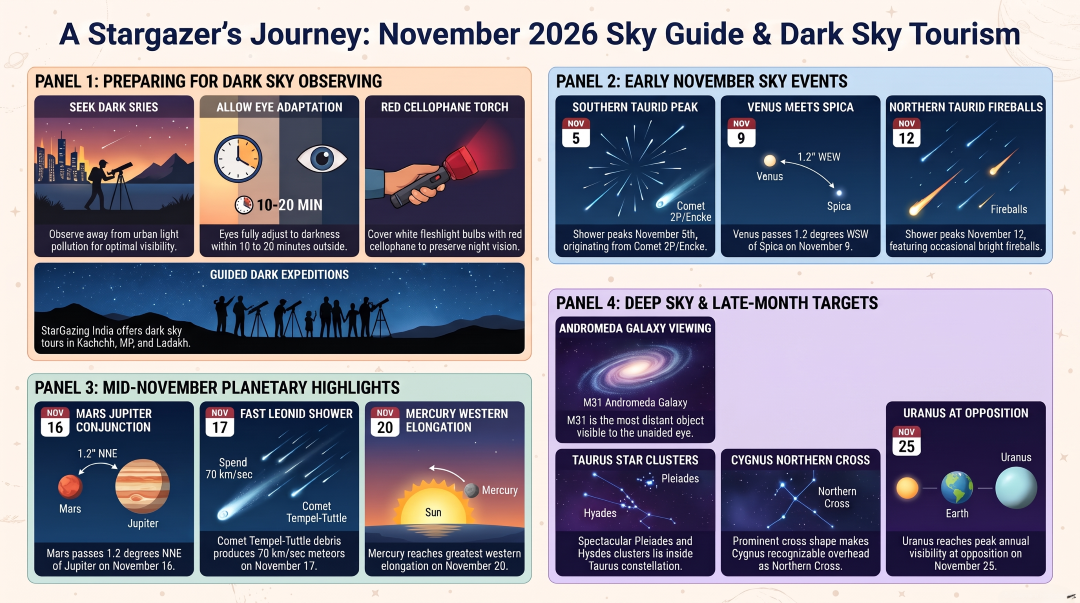
| Nov 05 (All Day) | Nov 05 (All Day / Night) | Southern Taurid Meteor Peak | Slow meteors; active Sept 23–Dec 8. Parent: Comet 2P/Encke. |
| Nov 07 @ 10:00 UT | Nov 07 @ 03:30 PM IST | Moon near Venus (Mag -4.4) | Daylight alignment. Observe in eastern dawn twilight. |
| Nov 09 @ 07:01 UT | Nov 09 @ 12:31 PM IST | New Moon (Lunation 1285) | Prime dark-sky weekend for deep-sky field observation. |
| Nov 09 @ 13:00 UT | Nov 09 @ 06:30 PM IST | Venus 1.2° WSW of Spica | Daylight alignment. Observe pre-dawn on Nov 09 & 10. |
| Nov 11 @ 05:00 UT | Nov 11 @ 10:30 AM IST | Moon near Antares | Low in south-southwestern evening twilight after sunset. |
| Nov 12 (All Day) | Nov 12 (All Day / Night) | Northern Taurid Meteor Peak | Renowned for bright fireballs; active Oct 13–Dec 02. |
| Nov 13 @ 18:00 UT | Nov 13 @ 11:30 PM IST | Lunar Apogee | Farthest from Earth (405,619 km; angular size: 29.5'). |
| Nov 16 @ 03:00 UT | Nov 16 @ 08:30 AM IST | Mars 1.2° NNE of Jupiter | Daylight alignment. Observe pre-dawn (04:30 AM IST). |
| Nov 17 @ 11:47 UT | Nov 17 @ 05:17 PM IST | First Quarter Moon | Lunar craters along terminator starkly visible at sunset. |
| Nov 17 (All Night) | Nov 17–18 (Pre-Dawn Peak) | Leonid Meteor Shower Peak | Hyper-velocity (70 km/s); ZHR 10–15 meteors/hour. |
| Nov 20 @ 21:00 UT | Nov 21 @ 02:30 AM IST | Moon near Saturn (Mag 0.6) | (Date Roll-Over) Prime evening and midnight target. |
| Nov 20 @ 23:00 UT | Nov 21 @ 04:30 AM IST | Mercury Western Elongation | 19.6° W of Sun (Mag -0.6). Prime pre-dawn eastern window. |
| Nov 24 @ 13:00 UT | Nov 24 @ 06:30 PM IST | Moon near the Pleiades | Dramatic eastern pairing rising during late evening. |
| Nov 24 @ 14:54 UT | Nov 24 @ 08:24 PM IST | Full Moon | Bright moonlight; ideal for lunar ray systems and landscapes. |
| Nov 25 @ 21:15 UT | Nov 26 @ 02:45 AM IST | Lunar Perigee | Closest to Earth (359,347 km; angular size: 33.3'). |
| Nov 25 @ 23:00 UT | Nov 26 @ 04:30 AM IST | Uranus at Opposition | Mag 5.6. Visible all night; peak brightness and diameter. |
| Nov 26 @ 05:00 UT | Nov 26 @ 10:30 AM IST | Mars 1.7° NNE of Regulus | Daylight alignment. Observe in eastern pre-dawn sky. |
| Nov 27 @ 19:00 UT | Nov 28 @ 00:30 AM IST | Venus at Greatest Brightness | Mag -4.65 beacon dominating the morning pre-dawn sky. |
| Nov 30 @ 08:00 UT | Nov 30 @ 01:30 PM IST | Moon near Jupiter (Mag -2.2) | Daylight alignment. Observe pre-dawn on Nov 30. |
| Nov 30 @ 14:00 UT | Nov 30 @ 07:30 PM IST | Moon near Regulus | Daylight alignment. Observe pre-dawn on Nov 30 & Dec 01. |
Field Observational Caveat — Daylight vs. Nocturnal Visibility: When celestial alignments occur at converted IST times during daylight or early dusk hours, the physical alignment is obscured by Earth or solar glare. For all events labeled "Morning Sky" that convert to daytime IST, conduct visual sessions during the pre-dawn window (04:15 AM to 05:30 AM IST) on the morning of or immediately following the listed date.
9. November Meteor Showers Analysis
Earth encounters multiple interplanetary debris streams during November, offering exceptional opportunities to observe cometary dust vaporization.
Comparative Meteor Stream Mechanics
| Metric / Feature | Southern Taurids | Northern Taurids | Leonids |
|---|---|---|---|
| Peak Night | November 05 | November 12 | November 17 into pre-dawn Nov 18 |
| Active Duration | Sept 23 – Dec 08 | Oct 13 – Dec 02 | Nov 06 – Nov 30 |
| Parent Body | Comet 2P/Encke | Taurid Complex | Comet 55P/Tempel-Tuttle |
| Atmospheric Velocity | Slow (~27 km/s) | Slow (~29 km/s) | Hyper-velocity (70 km/s) |
| Visual Appearance | Steady, gentle tracks | Bright fireballs (bolides) | Thin, pencil-like green-white ion trains |
| Expected Zenithal Rate | 5 – 10 meteors/hr | 5 meteors/hr (High fireballs) | 10 – 15 meteors/hr |
Atmospheric Entry Dynamics: Leonids vs. Taurids
- The Leonid Stream: Earth collides nearly head-on with the dust stream of Comet 55P/Tempel-Tuttle at an extreme velocity of 70 km/s. Atmospheric friction instantly superheats tiny sand-grain particles at altitudes near 100 km, producing incandescent green-white streaks that leave persistent, glowing ionized plasma trains lasting several seconds.
- The Taurid Complex: Originating from Comet 2P/Encke, Taurid particles strike Earth at an oblique angle and lower speed (27 km/s). Because deceleration occurs gradually, larger pebble-sized fragments survive into denser atmospheric layers, producing slow, long-lasting yellow-orange fireballs capable of casting brief shadows.
Field Protocol for Meteor Observation
- Ditch Optical Aids: Do not use telescopes or binoculars; their narrow fields of view drastically limit your chances of catching rapid streaks.
- Reclining Setup: Use a sleeping pad or reclining field chair to scan a wide 60° swath of sky without neck strain.
- Post-Midnight Focus: Observation rates peak in the hours after midnight, when the observing site turns into the forward-facing apex of Earth's orbital trajectory.
10. Planetary & Lunar Positions and Dynamics
November 2026 presents outstanding orbital configurations for both inner terrestrial worlds and outer gas giants.
Planetary Visibility Matrix
| Planet | Magnitude | Constellation | Optimal Viewing Window | Key Observational Highlights |
|---|---|---|---|---|
| Mercury | -0.6 | Libra / Scorpius | Pre-Dawn (Nov 20–23) | Greatest Western Elongation (19.6° from Sun on Nov 21 IST); highest morning elevation. |
| Venus | -4.65 | Virgo / Libra | Pre-Dawn | Reaches Peak Brilliance on Nov 28 IST; passes 1.2° from Spica on Nov 09. |
| Mars | 0.9 rightarrow 0.6 | Cancer / Leo | Pre-Dawn | Passes 1.2° from Jupiter on Nov 16; passes 1.7° from Regulus on Nov 26. |
| Jupiter | -2.0 rightarrow -2.2 | Cancer / Leo | Late Night to Dawn | Dominant pre-dawn gas giant; paired with the Moon on Nov 03 and Nov 30. |
| Saturn | 0.6 | Aquarius / Pisces | Evening to Post-Midnight | Prime evening target; ring plane comfortably tilted; paired with Moon on Nov 21 IST. |
| Uranus | 5.6 | Taurus | All Night (Sunset to Sunrise) | Reaches Opposition on Nov 26 IST; maximum diameter (3.8") and peak annual brightness. |
Lunar Orbital Extremes
| Event | Date & Time (IST) | Center-to-Center Distance | Apparent Angular Diameter | Field Significance |
|---|---|---|---|---|
| Lunar Apogee | Nov 13 @ 11:30 PM | 405,619 km | 29.5 arcminutes (29.5') | Smallest apparent size; minimal tidal pull. |
| Lunar Perigee | Nov 26 @ 02:45 AM | 359,347 km | 33.3 arcminutes (33.3') | Apparent diameter appears ~13% larger than at apogee. |
11. Practical Observation Field Guide & Dark-Sky Preservation
Visual acuity under the night sky is heavily influenced by site selection, night-vision management, and schedule alignment with lunar cycles.
Dark-Sky Observing Principles
| Rule / Principle | Operational Field Directive | Scientific Rationale |
|---|---|---|
| 1. Site Selection | Base expeditions at certified dark sites (e.g., MP Astro Village, Kachchh, Ladakh). | Escapes artificial light domes that wash out faint outer galactic disks and nebulae. |
| 2. Dark Adaptation | Maintain absolute darkness for 15 to 20 minutes before observing. | Allows retinal rods to synthesize maximum concentrations of the visual pigment rhodopsin. |
| 3. Red Light Mandate | Cover all torches and equipment indicators with deep red filters. | Long-wavelength red light (>620 nm) does not bleach rhodopsin or reset night vision. |
| 4. Lunar Scheduling | Schedule deep-sky hunts around New Moon (Nov 09); reserve Full Moon for bright targets. | Natural lunar scatter brightens the background sky, extinguishing low-surface-brightness targets. |
12. Sky Map Legend & Standard Symbols
Standardized cartographic symbols enable astronomers to rapidly decode celestial charts and plan observation sequences.
Cartographic Symbol Classifications
| Chart Symbol Pattern | Object Classification | Astrophysical Description | Typical Field Instrument |
|---|---|---|---|
| Oval Spiral Symbol | Galaxy | Giant gravitationally bound system of stars, gas, and dark matter | Binoculars / Medium Telescopes |
| Dotted Star Circle | Open Star Cluster | Young cluster of tens to hundreds of stars formed together | Wide-Field Binoculars |
| Dense Bold Star Circle | Globular Star Cluster | Ancient, densely packed spherical swarm of thousands of stars | Binoculars / Telescopes |
| Irregular Shaded Cloud | Diffuse Nebula | Interstellar cloud of glowing hydrogen gas and dust | Telescopes + Nebular Filters |
| Ringed Point Symbol | Planetary Nebula | Expanding glowing shell of gas ejected by a dying star | Telescopes (100×+) |
| Rayed Double Points | Double / Binary Star | Two stars in close angular proximity (optical or physical) | Telescopes (Splitting optics) |
| Concentric / Slashed Star | Variable Star | Star exhibiting measurable fluctuations in visual luminosity | Eyes / Binoculars (Photometry) |
Inverse Stellar Magnitude Scale
$Scale: -1 0 1 2 3 4$
- Logarithmic Inversion: Astronomical magnitudes operate on an inverse logarithmic scale where each drop of 5 magnitudes represents a 100× increase in brightness. Lower and negative numbers denote brighter objects (e.g., Venus at Mag -4.65 far outshines Vega at Mag 0.03 and Polaris at Mag 1.98).
13. Complete Astronomical Glossary
- Conjunction: An alignment where two celestial bodies reach their minimum angular separation as viewed from Earth.
- Constellation: One of the 88 internationally recognized sectors dividing the celestial sphere.
- Diffuse Nebula: An interstellar cloud of ionized gas and reflective dust illuminated by embedded stellar radiation.
- Double Star: Two stars appearing close together in the sky—either gravitationally linked (physical binary) or aligned along the same line of sight (optical double).
- Ecliptic: The apparent path of the Sun across the celestial sphere over the course of a year.
- Elongation: The angular distance between the Sun and a planet as viewed from Earth; greatest elongation marks the optimal viewing window for Mercury and Venus.
- Galaxy: A massive gravitational structure containing millions to trillions of stars, dust, and dark matter.
- Globular Star Cluster: A tightly bound, spherical cluster of ancient stars residing primarily in galactic halos.
- Light Year (ly): The distance traversed by light in a vacuum in one Julian year (9.46 × 10^{12} km).
- Magnitude: The apparent visual brightness of a celestial body as seen from Earth.
- Open Star Cluster: A loosely bound group of young stars formed from the same giant molecular cloud.
- Opposition: An orbital alignment where an outer planet lies directly opposite the Sun with Earth in between (180° elongation).
- Planetary Nebula: An expanding shell of glowing ionized gas cast off by an intermediate-mass star during its asymptotic giant branch phase.
- Universal Time (UT): The primary international standard for astronomical calculations (IST = UT + 5h 30m).
- Variable Star: A star whose apparent luminosity changes over time due to internal pulsations or orbital eclipses.
14. Best Observing Opportunities of November 2026 & Field Checklist
Master Field Observation Checklist
| Observation Tier | Primary November 2026 Field Targets | Recommended Viewing Window |
|---|---|---|
| Naked Eye | • Andromeda Galaxy (M31): Faint 2.5 million ly oval glow overhead. • The Pleiades (M45) & Hyades: Sparkling clusters in Taurus. • Leonid Meteor Shower Peak: Hyper-velocity streaks (70 km/s). |
Nov 07–12 (Moonless window) Late evening / midnight Night of Nov 17 into pre-dawn Nov 18 |
| Binoculars | • Double Cluster in Perseus (NGC 869 / 884): Twin star fields. • Great Hercules Globular (M13): Distinct fuzzy ball. • Coathanger Asterism (Cr 399): Iconic coat hanger geometry. • Auriga Trio (M36, M37, M38): Glowing open cluster fields. • Herschel’s Garnet Star (μ Cep): Ruby red supergiant. |
Entire month under dark skies Early evening before Hercules sets Post-sunset western sky Midnight to pre-dawn High northern sky all evening |
| Telescopes | • Albireo (β Cyg): Topaz gold and emerald blue binary split. • Ring Nebula (M57) & Saturn Nebula (NGC 7009). • Uranus at Opposition: 3.8" teal planetary disk (Mag 5.6). • Almach (γ And): Fine 9.8" color-contrast split. |
Early evening in Cygnus Early evening in Lyra / Aquarius Nov 25–26 (All night long) Overhead throughout the night |
| Key Phenomena | • New Moon Window: Prime dark-sky expedition period. • Mercury Greatest Elongation: 19.6° separation from Sun. • Venus at Greatest Brilliance: Blazing morning beacon (Mag -4.65). |
Weekend of Nov 07–09 Nov 21 Pre-Dawn (04:30 AM IST) Nov 28 Pre-Dawn (04:30 AM IST) |
November 2026 offers brilliant stargazing conditions as autumn constellations clear the zenith and the bright beacons of winter ascend in the east. The clear post-monsoon skies make this an ideal month to explore the night sky across India.
On behalf of our entire field operations team, educators, and telescope hosts at StarGazing India—pioneering Indian astro-tourism since 1991—we wish all students, amateur astronomers, and astro-tourists clear, dark skies and unforgettable observational discoveries under India's night sky.
Clear skies, and keep looking up!