
Astronomy Explained
Cosmos Explained: Universe, Galaxies, Planets & Our Place in Space | StarGazing India
Published on September 1, 2026 by Nishant Gor, Stargazing India
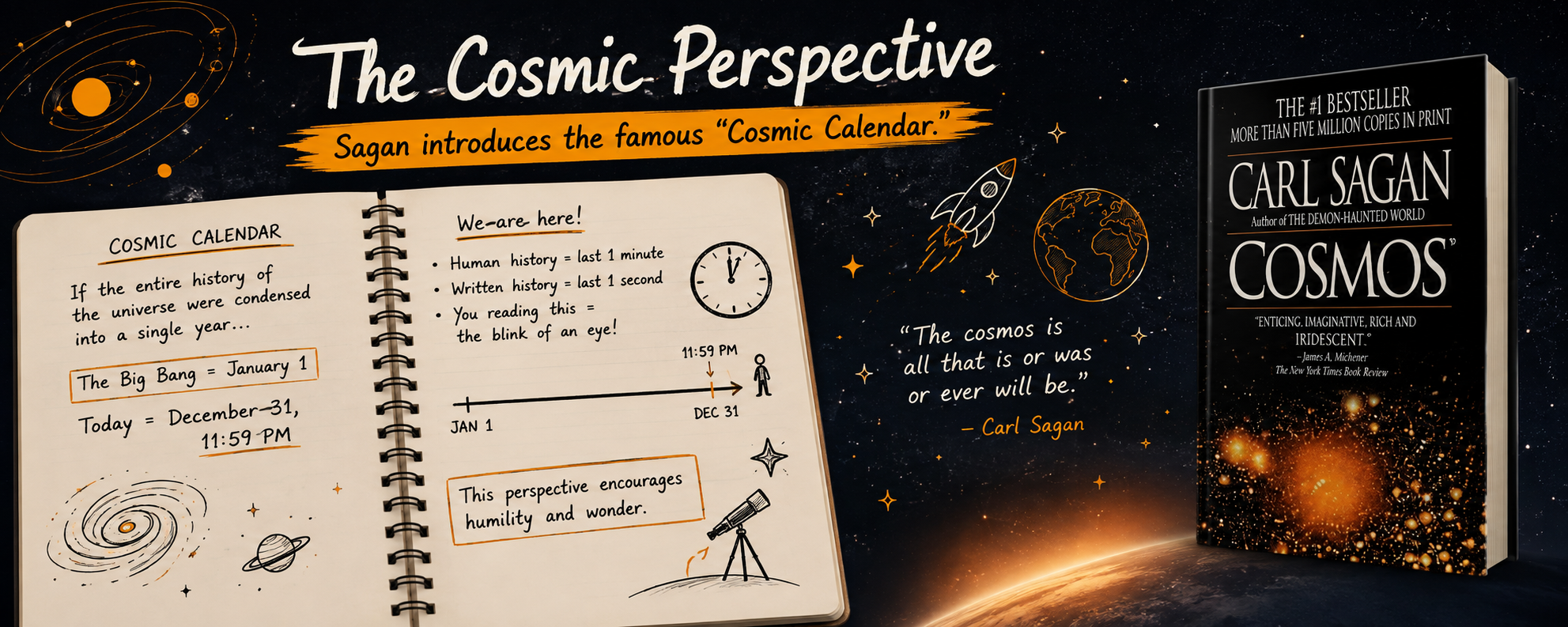
Cosmos: Understanding Our Place in the Universe
The Cosmos is everything that exists, has existed, or will ever exist. It includes galaxies, stars, planets, life, time, space—and us.
At StarGazing India, we believe astronomy is not only about looking through a telescope. It is about understanding where we came from, how the universe works, and our place within something far larger than ourselves.
From Earth to the Cosmic Ocean
The scale of the universe is almost impossible to imagine. Distances between stars and galaxies are measured in light-years—the distance light travels in one year, nearly 9.5 trillion kilometres.
Our home galaxy, the Milky Way, contains billions of stars, while our neighbouring Andromeda Galaxy (M31) is part of the same Local Group of galaxies.
Yet, despite this enormous scale, everything we know begins from one small planet: Earth.
And Earth has given us something extraordinary—the ability to observe the universe and ask questions about it.
How Humans Learned to Understand the Sky
Astronomy has a long history.
More than two thousand years ago, scholars in ancient Alexandria began using mathematics and observation to understand the natural world. Eratosthenes, for example, used shadows and geometry to estimate the circumference of Earth with remarkable accuracy.
Over time, astronomy moved from explanations based largely on mythology and speculation toward measurement, mathematics and evidence.
The transition from an Earth-centred universe to a Sun-centred Solar System was one of the greatest intellectual changes in human history.
Copernicus proposed the heliocentric model.
Kepler discovered that planets travel in elliptical orbits.
Newton explained planetary motion through universal gravitation.
Their work established a powerful idea:
The same laws of nature apply throughout the Cosmos.
Kepler, Newton and the Motion of Worlds
Kepler's three laws transformed our understanding of planetary motion.
Planets move in elliptical orbits, their speeds change as they travel around the Sun, and their orbital periods are related to their distance from it.
Newton later showed that gravity connects everything—from an object falling on Earth to the Moon orbiting our planet and planets orbiting the Sun.
The night sky was no longer simply something beautiful to observe.
It became something we could measure, calculate and understand.
We Are Part of the Cosmic Story
Astronomy also leads us back to Earth.
Every living organism we know shares a remarkable biological connection through DNA. Evolution, operating over immense periods of time, produced the diversity of life we see today.
The atoms that make our bodies were also forged through cosmic processes. In that sense, studying the universe is also studying our own origins.
We are not separate from the Cosmos.
We are made from it.
Other Worlds: Lessons from Venus and the Moon
Our neighbouring worlds demonstrate how different planetary environments can become.
Venus, with its dense carbon-dioxide atmosphere, extreme temperatures and runaway greenhouse effect, provides an important example of planetary climate processes.
The Moon, meanwhile, carries a record of impacts from the early Solar System. Its heavily cratered surface reminds us that collisions have played an important role in shaping planetary worlds.
Events such as the Tunguska explosion of 1908 also demonstrate that Earth exists within an active Solar System where asteroids and comets can sometimes pose real hazards.
Understanding these events is not about creating fear.
It is about understanding our environment—and preparing intelligently for the future.
Why Science Matters
Science gives us something extraordinarily valuable: a method for finding out what is true.
Observation gives us evidence.
Mathematics helps us describe it.
Experiment tests our ideas.
Skepticism challenges our assumptions.
Imagination allows us to ask better questions.
That combination has taken humanity from observing stars with the naked eye to sending spacecraft across the Solar System and studying galaxies billions of light-years away.
But scientific knowledge also brings responsibility.
Our technology gives us the ability to explore the universe—and the ability to profoundly affect our own planet.
Understanding the Cosmos should therefore give us not only knowledge, but also perspective and humility.
The Cosmic Perspective
When we compare an average human lifetime with the age of the universe, our existence occupies an almost unimaginably small fraction of cosmic history.
Yet within that tiny window, something remarkable has happened.
Matter became stars.
Stars created heavier elements.
Planets formed.
Life emerged.
And eventually, life became capable of looking back at the universe and asking:
“Where did all of this come from?”
That is perhaps the greatest wonder of astronomy.
The universe is enormous—but our curiosity allows us to explore it.
Look Up. Ask Questions. Explore.
At StarGazing India, our aim is to make this cosmic perspective accessible to everyone—from a child seeing Saturn through a telescope for the first time to an experienced observer exploring distant galaxies.
You don't need to be an astronomer to begin.
You only need to look up. 🌌
The Cosmos is not somewhere far away.
We are already a part of it.