
Astronomy Explained
Book Review | A Brief History of Time by Stephen Hawking | Understanding the Universe | StarGazing India
Published on June 1, 2026 by Nishant Gor - Stargazing India
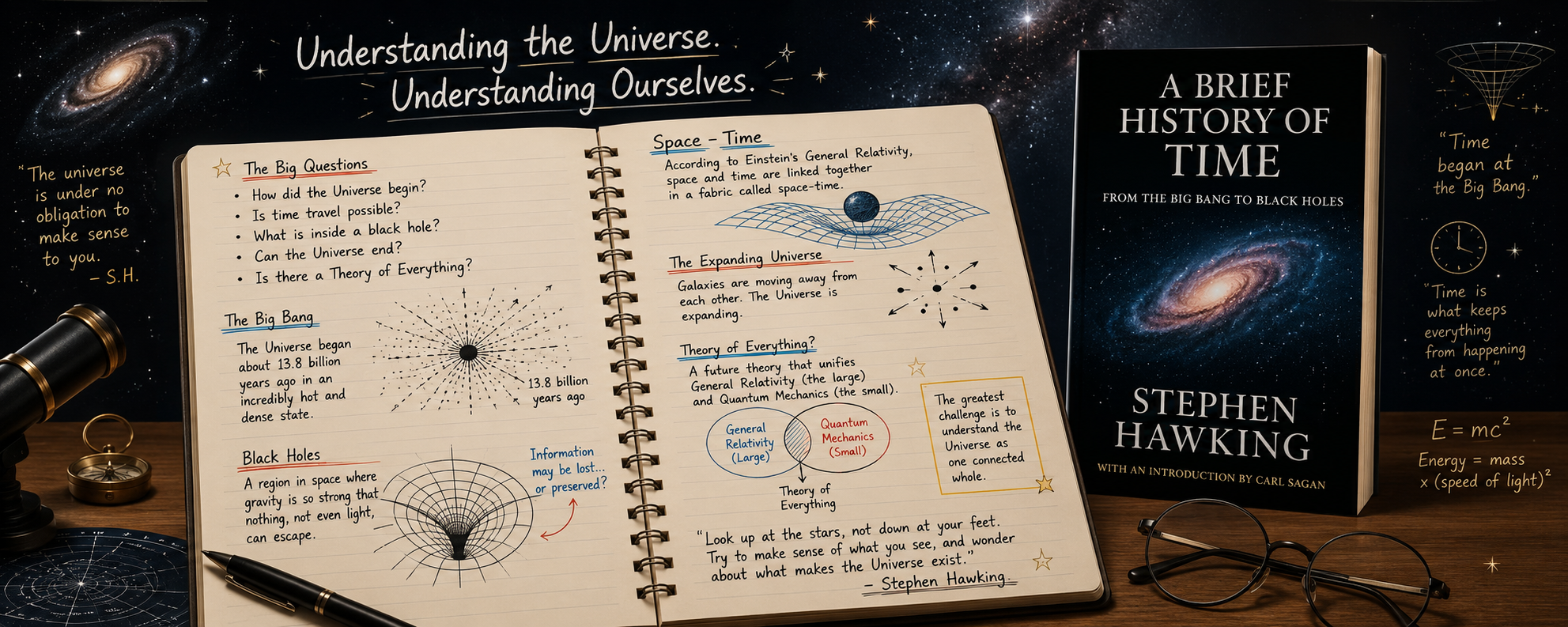
🌌 A Brief History of Time: Exploring the Universe Through Stephen Hawking’s Eyes
A Journey into the Biggest Questions Ever Asked
Some books tell us stories about the world around us.
Some books take us to places we may never physically visit.
And then there are books like A Brief History of Time by Stephen Hawking—books that take us beyond our planet, beyond the Solar System, beyond the Milky Way, and into the deepest questions humanity has ever asked.
Where did the Universe come from? Did time have a beginning? Will the Universe eventually end? What happens inside a black hole? Can we discover one fundamental theory that explains everything?
Stephen Hawking's A Brief History of Time is an extraordinary attempt to make these enormous questions accessible to ordinary readers. It is not simply a book about physics. It is a journey through space, time, gravity, black holes and the origin of the Universe.
For anyone who has ever looked at the night sky and wondered what lies beyond the stars, this book opens a door into one of the greatest intellectual adventures in human history.
🌌 From Looking at the Sky to Understanding the Universe
Humanity's relationship with the night sky is ancient.
Long before telescopes, spacecraft and observatories, people looked upward and tried to understand the changing patterns of the Sun, Moon, planets and stars.
Ancient civilizations used the sky for:
- Measuring time
- Creating calendars
- Navigation
- Agriculture
- Religious and cultural traditions
- Understanding seasonal changes
But gradually, our questions became deeper.
We stopped asking only:
“What can we see in the sky?”
And started asking:
“What is the Universe?”
This transition—from simply observing the heavens to scientifically understanding them—is at the heart of modern astronomy and cosmology.
A Brief History of Time takes readers through this remarkable journey.
🕰️ What Exactly Is Time?
Time is something we experience every moment of our lives.
We measure it with clocks.
We divide it into seconds, minutes, hours, days and years.
But from a scientific perspective, time is far more mysterious than it appears.
Stephen Hawking explores one of the most fascinating ideas developed through modern physics:
Time is connected to space.
According to Einstein's theory of relativity, space and time are not completely separate entities. Together, they form what physicists describe as space-time.
Massive objects such as stars and planets affect the geometry of space-time, and this relationship is deeply connected with gravity.
This completely transformed the way scientists understand the Universe.
The Universe was no longer viewed as a simple, fixed stage where events happen.
Instead, the stage itself—space and time—can change.
🌠 The Expanding Universe
One of the most revolutionary discoveries of modern astronomy was the realization that the Universe is not static.
It is expanding.
When astronomers observe distant galaxies, they find evidence that, on large scales, galaxies are moving away from one another.
This discovery led scientists toward an extraordinary conclusion:
If the Universe is expanding today, then in the distant past, everything must have been much closer together.
This idea became central to our modern understanding of the Big Bang.
The Big Bang is often misunderstood as an explosion occurring at one particular location in empty space.
A better way to think about it is that space itself has been expanding.
As we look farther into space, we also look farther back in time.
Light from distant galaxies takes millions or billions of years to reach us.
That means a telescope is not simply an instrument for looking across distance.
It is also a kind of time machine.
When we observe distant objects, we see them as they existed in the past.
💥 The Big Bang: Did Time Have a Beginning?
One of the central themes of A Brief History of Time is the origin of the Universe.
If we trace the expansion of the Universe backward, we reach an extremely hot and dense early state.
This leads to one of the greatest questions in cosmology:
Did the Universe have a beginning?
And if time itself began with the Universe, another question follows:
What does “before the beginning” even mean?
These are not simple philosophical questions.
They are deeply connected with physics, mathematics and our understanding of the fundamental laws of nature.
Hawking's work encouraged people to think about these questions seriously—not as myths or speculation, but as scientific problems that could potentially be explored through observation and theory.
🕳️ Black Holes: Where Gravity Becomes Extreme
Perhaps no subject associated with Stephen Hawking is more famous than black holes.
A black hole is a region of space where gravity becomes extraordinarily strong.
Beyond a boundary known as the event horizon, the gravitational pull becomes so intense that nothing—not even light—can escape.
For a long time, black holes were considered strange mathematical possibilities.
Today, they are among the most fascinating objects in modern astronomy.
We now have evidence for black holes throughout the Universe, including the supermassive black hole at the centre of our own Milky Way Galaxy.
But Stephen Hawking helped transform our understanding of black holes even further.
His theoretical work led to the idea now known as Hawking Radiation.
The idea suggested that black holes may not be completely black after all.
Quantum effects near the event horizon could allow them to emit radiation.
This was a revolutionary concept because it connected:
- Gravity
- Quantum mechanics
- Thermodynamics
- Black hole physics
And it created new questions that scientists continue to investigate today.
⚛️ The Strange World of Quantum Physics
To understand the largest structures in the Universe, scientists need theories such as General Relativity.
To understand the smallest scales of nature, they use Quantum Mechanics.
Both theories have been incredibly successful.
General Relativity helps explain:
- Gravity
- Planetary motion
- Stars
- Black holes
- The large-scale structure of the Universe
Quantum Mechanics helps explain:
- Atoms
- Subatomic particles
- Radiation
- The microscopic behaviour of matter
The challenge is that these two great frameworks are difficult to combine completely.
And this leads to one of the most ambitious dreams in theoretical physics:
A Theory of Everything
Could there be one unified framework capable of explaining all the fundamental forces and laws of nature?
This question runs through the scientific journey described in A Brief History of Time.
🔭 Astronomy Is More Than Looking Through a Telescope
At StarGazing India, we often introduce people to astronomy through direct observation.
A telescope might reveal:
🌙 Craters on the Moon 🪐 Rings of Saturn 🔴 The changing appearance of Mars ✨ Star clusters 🌌 Nebulae and distant galaxies
But astronomy does not end at the telescope.
Every object we observe raises another question.
When we look at the Moon, we can ask:
How did it form?
When we observe Jupiter, we can ask:
How did planets form around young stars?
When we see the Milky Way, we can ask:
How many stars exist within our galaxy?
And when we look into the darkness between the stars, we eventually arrive at the biggest question of all:
What is the Universe, and how did it begin?
That is where astronomy becomes cosmology.
🌌 Why This Book Still Matters
A Brief History of Time became one of the world's most famous science books because it brought difficult scientific ideas into public conversation.
It encouraged people who were not professional scientists to think about:
- The origin of the Universe
- The nature of time
- Black holes
- Gravity
- Quantum physics
- The future of the Cosmos
Perhaps its greatest achievement was reminding millions of readers that science belongs to everyone.
You do not need to be a physicist to be curious.
You do not need a laboratory to ask questions.
And you do not need to understand every equation before beginning your journey into the Universe.
Curiosity is enough to start.
🧠 The Universe and the Human Mind
There is something deeply remarkable about our existence.
The Universe produced stars.
Stars created many of the chemical elements necessary for planets and life.
Planets formed around stars.
On at least one planet, life emerged.
And eventually, that life evolved to a point where it became capable of studying the Universe from which it came.
We are part of the Universe.
Yet we are also capable of asking questions about it.
We can observe galaxies billions of light-years away.
We can detect gravitational waves produced by colliding black holes.
We can send spacecraft beyond our Solar System.
And we can use mathematics to describe events that happened billions of years before humans existed.
That may be one of the most extraordinary facts of all.
🌠 A Book That Begins with Curiosity
The true beauty of A Brief History of Time is not that it provides simple answers to every cosmic mystery.
It does something more valuable.
It teaches us to appreciate the questions.
The Universe remains full of mysteries.
What is dark matter?
What is dark energy?
What happens at the deepest level inside a black hole?
How did the Universe begin?
Will we ever discover a complete unified theory of nature?
These questions remain open.
And that is exactly what makes astronomy and cosmology so exciting.
Every answer leads to another question.
Every discovery opens another door.
🌌 StarGazing India and the Journey of Cosmic Discovery
At StarGazing India, we believe that astronomy should not remain limited to textbooks, classrooms or professional observatories.
The Universe belongs to everyone.
A child looking at the Moon through a telescope for the first time is beginning the same journey of curiosity that has inspired astronomers for thousands of years.
A traveller standing beneath the Milky Way is experiencing the scale of the Cosmos directly.
An amateur astrophotographer capturing distant stars is recording light that has travelled across unimaginable distances.
And someone opening a book like A Brief History of Time is taking another important step:
Trying to understand what they are looking at.
That is the real spirit of astronomy.
✨ Look Up. Ask Questions. Never Stop Exploring.
Stephen Hawking's A Brief History of Time reminds us that the Universe is not simply something above our heads.
We are part of it.
The atoms around us, the planets we observe, the stars we photograph and the galaxies we study are all part of the same cosmic story.
And perhaps the greatest thing about that story is that it is still being written.
There are discoveries waiting in the darkness.
There are questions we have not yet learned to ask.
And somewhere between the smallest particles and the largest galaxies, humanity continues its search for understanding.
So the next time you look through a telescope—or simply step outside and look at the stars—remember:
You are not standing outside the Universe and observing it. You are the Universe, trying to understand itself.
🌌 Look Up. Explore. Question. Discover.
🔭 StarGazing India
Connecting People with the Universe, One Sky at a Time.
For More Detailed Explainer : https://youtu.be/DpcdnhhEstI
Credits : Book | A Brief History of Time — Stephen Hawking