
StarGazing India Presents: Your Ultimate Guide to the Celestial Wonders of January 2026
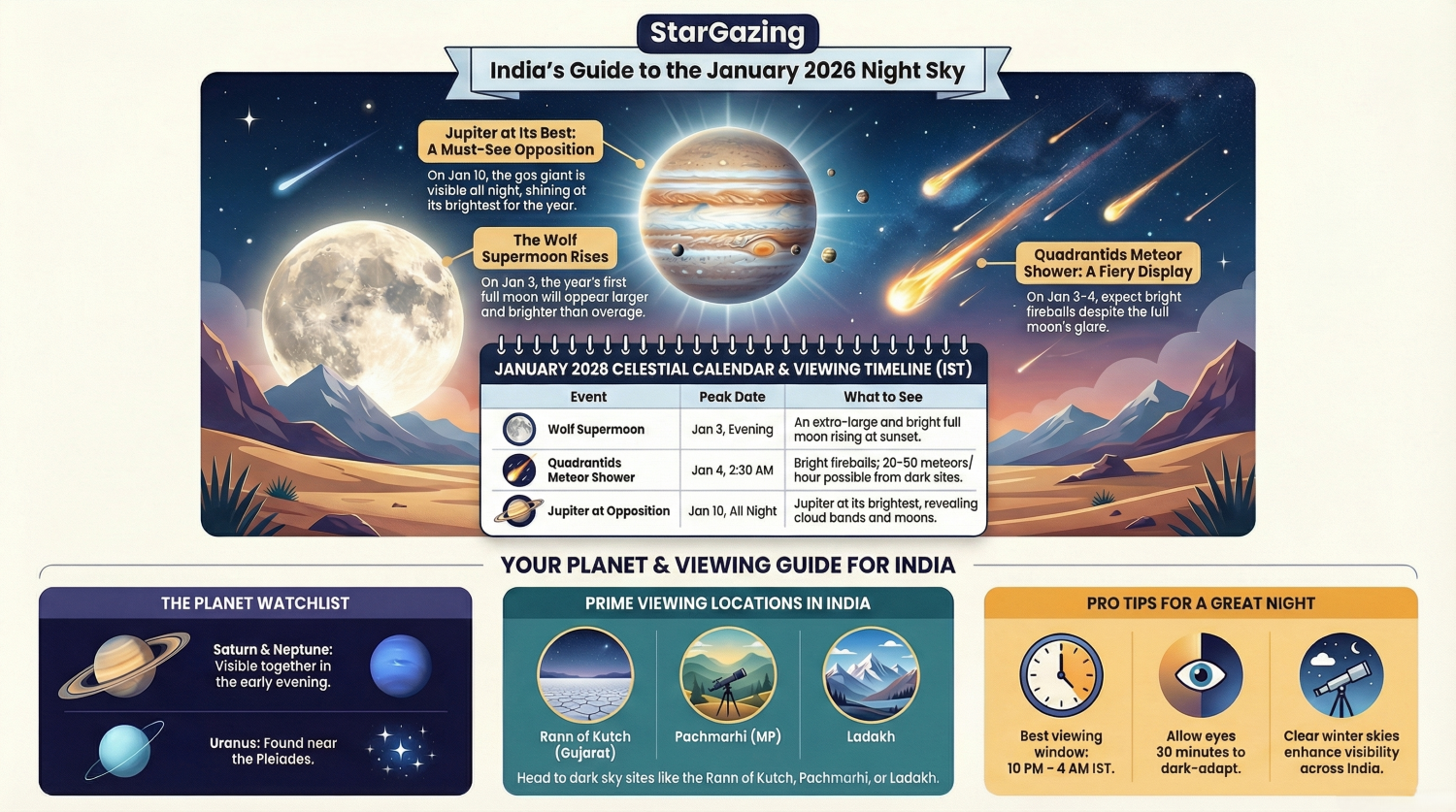
Greetings from the team at StarGazing India, and a very happy new year! January 2026 offers a spectacular start to the year for stargazers across the Indian subcontinent. The crisp, clear winter air provides a perfect window to the cosmos, and our mission is to help you experience it by blending science with culture and heritage under India's pristine skies.
This month is packed with celestial drama. We have two main headliners competing for your attention: the planet Jupiter, putting on its best and brightest show of the year, and the dramatic Quadrantid meteor shower, which will face a dazzling challenger in the form of a bright Supermoon. This guide is your companion to these events and more. We'll walk you through what to see, when to see it, and how to enjoy the majestic clockwork of the universe right from your own backyard. Let's begin our journey.
1. The Main Events: Your Must-See Celestial Spectacles
These are the can't-miss celestial highlights that will define stargazing in January 2026.
A. Jupiter's Grand Performance: The King of Planets at its Best
On the night of January 10th, Jupiter will reach "opposition." Think of it like a celestial lineup: the Sun, Earth, and Jupiter will form a straight line, with Earth in the middle. This means Jupiter will be at its closest point to us for the year, making it appear bigger, brighter, and visible all night long. It will rise in the east as the sun sets in the west, dominating the sky as a dazzling, star-like object shining at a brilliant magnitude of –2.7 in the constellation Gemini.
Here’s how you can enjoy the king of planets with whatever equipment you have:
- With the Naked Eye: Jupiter will be impossible to miss. Look for an exceptionally bright, steady, star-like light in the high eastern sky after sunset. It will outshine every true star in the sky.
- With Binoculars: Even a standard pair of binoculars will transform Jupiter from a point of light into a small, distinct disk. But the real magic is spotting its four largest moons—Io, Europa, Ganymede, and Callisto. Known as the Galilean moons, they will appear as tiny pinpricks of light dancing in a line around the planet.
- With a Small Telescope: A telescope brings Jupiter to life. You'll be able to see its two dark equatorial cloud belts stretching across its surface. Patient observers might even glimpse the famous Great Red Spot, a colossal storm raging in the planet's southern hemisphere. Telescopically, its disk will appear 46 arcseconds wide, offering a wealth of detail. You can experience this firsthand through our 8-inch telescopes at our Rann Utsav star parties.
B. The Dance of the Galilean Moons
The days surrounding opposition are the perfect time to watch the Galilean moons perform. You can see them transit (pass in front of) Jupiter, get occulted (disappear behind it), and even cast their tiny shadows onto the planet's swirling cloud tops. Here are some of the most spectacular events to watch for with a telescope.
| Date (IST) | What to Watch For |
|---|---|
| Jan 8, ~1:50 AM | Io and its Shadow Transit Together: Watch as the tiny moon Io and its inky black shadow appear to touch as they cross Jupiter's face. Before opposition, the shadow always leads the moon. |
| Jan 10, ~2:00 AM–6:00 AM | Extremely Rare Callisto Transit: A must-see! On the morning of opposition, the Sun, Earth, and Jupiter are perfectly aligned. This creates a rare "crossover" event where Callisto transits Jupiter while nearly overlapping its own shadow. |
| Jan 11, ~11:20 PM | Europa and its Shadow Transit Together: Europa and its shadow will appear to touch as they cross Jupiter's disk. This is a great opportunity to observe the subtle differences between the moon and its shadow. |
| Jan 27, ~2:46 AM | Callisto Transits Again: Well after opposition, watch the slow-moving moon Callisto begin another transit. Note how its shadow now clearly trails behind it, a visible demonstration of our changing viewing angle. |
C. The Quadrantids vs. The Supermoon: A Fiery Challenge
The Quadrantid meteor shower is one of the year's most intense, with the potential for over 100 meteors per hour. It peaks on the night of January 3rd-4th, with its fiery trails originating from the debris of an asteroid named 2003 EH1. However, this year presents a classic celestial showdown:
- Pro: The Quadrantids are famous for producing exceptionally bright and colorful meteors known as "fireballs." These can light up the entire sky for a moment.
- Con: The shower's peak coincides with the January 3rd Wolf Supermoon. This full moon occurs when the Moon is at its perigee, or closest point to Earth, making it appear larger and brighter than usual. Its brilliant light will wash out all but the most stunning meteors. As a celestial coincidence, this also happens on the same day Earth reaches perihelion, its closest point to the Sun. In Gujarat's villages, this bright winter moon is a perfect backdrop for cultural storytelling.
For observers in India, here is our practical advice for catching the show:
- Manage Expectations: The bright moonlight means you won't see 120 meteors per hour. Instead, from a dark, rural location like the outskirts of Bhuj, a realistic rate is 20-50 fireballs and bright meteors per hour.
- Timing is Everything: The best time to watch is in the early morning hours of January 4th, after midnight IST. The Quadrantids are known for a very short, sharp peak of only a few hours, so timing is critical. By then, the shower's radiant point in the constellation Boötes will be high in the northern sky.
- Location Matters: Find a spot with an open view of the northern sky, as far from city lights as possible. The vast salt flats of the Rann of Kutch or the dark, forested areas of Madhya Pradesh—where we train local youth to become the next generation of astro-guides—are perfect examples of prime viewing locations.
While Jupiter and the Quadrantids demand the spotlight, other planets are putting on their own quiet shows in the evening sky.
2. A Tour of the Planets: Who Else is visiting?
While some planets are hiding this month, a few others offer rewarding views for those who know where and when to look.
A. The Distant Duo: Saturn and Neptune
Saturn is visible in the early evening sky in the constellation Aquarius, crossing into Pisces on January 15th. Shining at magnitude 1.0, it offers a truly unique viewing opportunity this year. The planet's famous rings are tilted at a very shallow angle to us—between 1° and 2.2°. This means that in small telescopes, they will look like a razor-thin line of light. Don't see this as a lesser view; it's a rare chance to see Saturn's globe unobstructed by its usually brilliant rings. You can also spot its largest moon, Titan, as a small point of light nearby.
This is also an excellent month to hunt for Neptune. The dim, bluish planet (magnitude 7.8) remains very close to the much brighter Saturn all month long. Use Saturn as your guidepost, and with a pair of binoculars or a small telescope, you can track down the solar system's most distant major planet.
B. The Other Giants and Dwarfs: Uranus and a Famous Asteroid
Uranus is well-placed for viewing high in the sky after sunset. Shining at magnitude 5.7 in the constellation Taurus, it can be spotted with binoculars just south of the famous Pleiades (M45) star cluster. A telescope will reveal its pale greenish disk.
For those with a small telescope, the asteroid 16 Psyche can be spotted this month near the bright star Aldebaran. This is no ordinary space rock; it is a metallic world and the target of NASA's Psyche mission. Now is a great time to track this object of modern scientific interest as it moves slowly against the background stars.
C. The Shy Planets: A Quick Hello and Goodbye
It's a quiet month for the inner planets.
- Venus and Mars are not visible this month, as they are on the far side of the Sun from our perspective (a position called conjunction).
- Mercury makes an extremely brief appearance on the morning of New Year's Day, glowing low in the southeastern sky about 30 minutes before sunrise. After that, it disappears into the Sun's glare for the rest of January.
To help you keep track of all these celestial movements, here is a day-by-day guide to January's sky.
3. Your Celestial Calendar for January 2026 (All Times in IST)
| Date (IST) | Event | Viewing Notes & Location Tips |
|---|---|---|
| Jan 3, 3:34 PM | Wolf Supermoon | The year's first full moon will be extra large and bright. Rises at sunset. A stunning sight over the Rann of Kutch or Bandhavgarh forests. |
| Jan 3–4 | Quadrantid Meteor Shower Peak | An intense shower challenged by the full moon. Look for bright fireballs after midnight. Best from dark sites like the Bhuj outskirts or Odisha's coast. |
| Jan 10 | Jupiter at Opposition | The best night of the year to see Jupiter! It's visible all night, rising at sunset. Perfect for viewing from anywhere in India, especially high-altitude sites like Hanle, Ladakh. |
| Jan 14, ~8:00 PM | Lunar Occultation of Antares | Watch the waxing gibbous Moon pass in front of and briefly hide the bright red star Antares. Best seen with a small telescope from the plains of Gujarat. |
| Jan 18, 2:30 AM | New Moon | With no moonlight, this is the perfect time for deep-sky observing. Ideal for spotting faint objects like the Beehive Cluster (M44) from the Kutch deserts. |
| Jan 23, ~7:00 PM | Moon near Saturn & Neptune | A thin crescent Moon joins Saturn and Neptune in the western evening sky. Use binoculars to sweep the area and spot all three. Great from Khajuraho. |
| Jan 25, 5:45 PM | First Quarter Moon | The half-lit Moon offers fantastic views of craters and mountains along its terminator (the line between light and shadow). |
| Jan 27, ~8:00 PM | Moon near the Pleiades (M45) | A beautiful sight for the naked eye and binoculars as the crescent Moon passes the famous "Seven Sisters" star cluster. A prime opportunity for photography. |
With this calendar in hand, you're ready to plan your nights. But before you head out, here are a few final tips to make your stargazing session a success.
4. Get Ready to Gaze: Stargazing Tips from Our Experts
A. Find Your Dark Sky Sanctuary
The single most important step to great stargazing is to escape the light pollution of our cities. Even a short drive of 10-20 km to a more rural area can make a dramatic difference. For an unforgettable experience, visit one of India’s pristine dark sky locations. The outskirts of our home base in Bhuj, for instance, boast Bortle 1 skies where the Milky Way is breathtakingly clear. Other ideal sites include the Rann of Kutch in Gujarat, the Satpura Tiger Reserve in Madhya Pradesh, or the unparalleled high-altitude sites in Ladakh.
B. Smartphone Astrophotography 101
You don't need a DSLR to capture the night sky. Your smartphone is a powerful tool if you know how to use it!
- Use Pro Mode: Switch your camera app to "Pro" or "Manual" mode to control the settings.
- ISO: Set your ISO (light sensitivity) to between 1600 and 3200.
- Shutter Speed: To capture faint starlight or meteor trails, use a long exposure of 8–16 seconds.
- Focus: Manually set the focus to infinity (often marked with a mountain symbol).
- Stability is Key: A tripod is essential. Any movement will blur the image during a long exposure, so keep your phone perfectly still.
- Share your results! Share your best shots with our community on social media @stargazingindia—we love to see what you capture!
Conclusion: Your Cosmic Journey Begins
January 2026 offers something for every stargazer, from the planetary grandeur of Jupiter's opposition to the fiery challenge of hunting for Quadrantid meteors against a Supermoon. More than just a list of events, this is a personal invitation to step outside, look up, and connect with the vast and beautiful universe we all share.
We hope this guide inspires you to explore the wonders of the January sky. The universe is full of stories, and we're here to help you read them.
Want to learn more?
- Read our other articles on our official blog.
- Join our community star parties in Bhuj by contacting Mr. Nishant Gor at +91-9879554770.
- Follow our journey on social media at @stargazingindia.
From all of us at StarGazing India, we wish you clear skies!