Night Sky Guide
Celestial Spectacles of December 2025
Published on December 4, 2025 by Mr. Nishant Gor
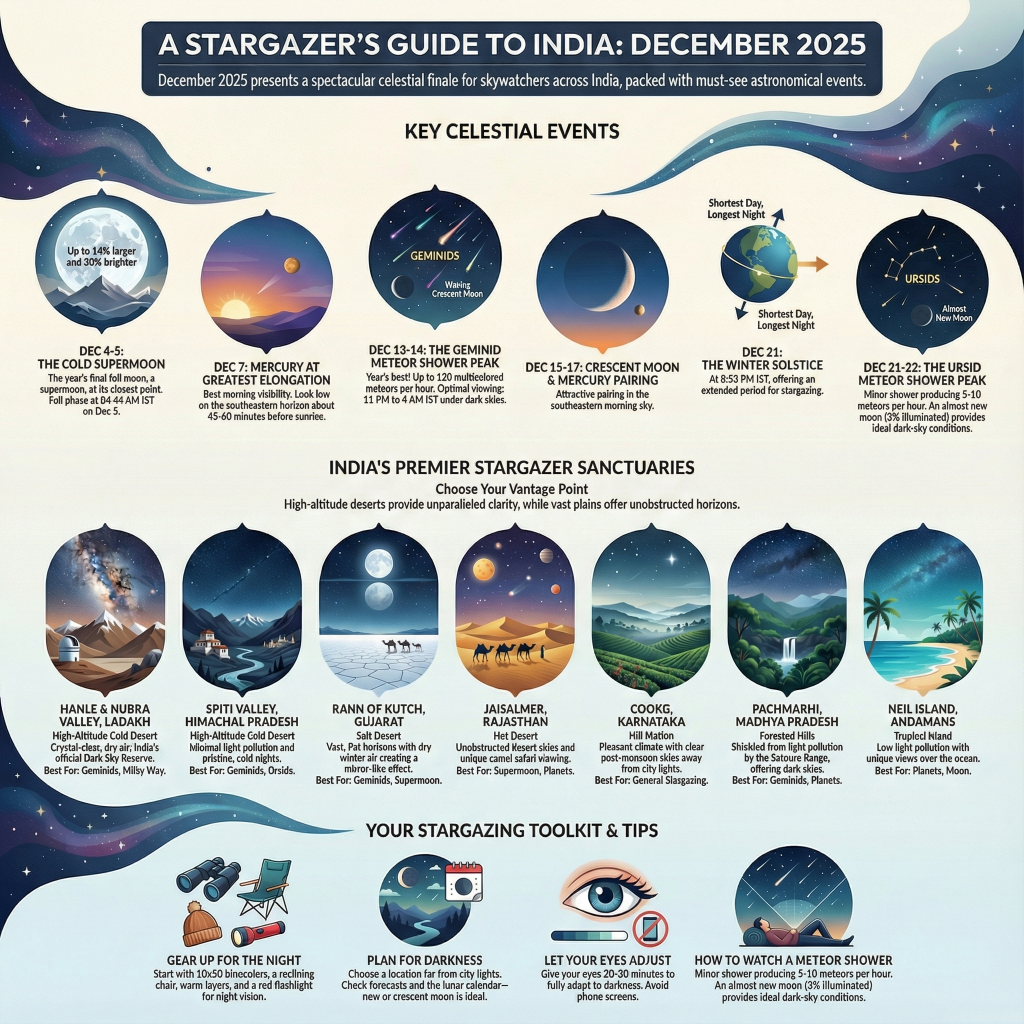
A Stargazer’s Guide to the Indian Night Sky
By Mr. Nishant Gor, StarGazing India
As winter settles over India—from the cold, clear nights of Ladakh and Kutch to the pleasant skies of the Deccan plateau—December 2025 emerges as one of the most rewarding months for skywatchers.
This month brings together:
- A bright supermoon,
- The best meteor shower of the year,
- A minor yet charming meteor shower near the solstice,
- And beautiful views of the brightest planets—all perfectly visible from Indian skies.
Whether you are observing from a dark village sky in Gujarat, a Himalayan homestay in Himachal, or even a relatively dark terrace in an Indian city, December 2025 offers multiple reasons to look up.
Quick Highlights for Indian Skywatchers
- Cold Supermoon (Full Moon): 4–5 December 2025 The last full moon of the year is also a supermoon, appearing slightly larger and brighter than average. The Moon turns full on 4 December at 23:14 UTC (early hours of 5 December in India).
- Geminid Meteor Shower: Peak Night 13–14 December 2025 The most reliable annual meteor shower, with the potential for 50–100 meteors per hour under dark Indian skies, and minimal interference from the waning Moon.
- December Solstice: 21 December 2025 Marks the winter solstice in the Northern Hemisphere—the shortest day and longest night of the year, ideal for extended stargazing sessions.
- Ursid Meteor Shower: Peak Night 21–22 December 2025 A modest meteor shower (around 5–10 meteors per hour) near the constellation Ursa Minor, with an almost moonless sky—excellent conditions for observers in northern India.
- Planetary Treats Jupiter dominates the evening sky, while Mercury makes a brief but beautiful appearance in the morning twilight, particularly during the first half of the month.
1. The Cold Supermoon – 4–5 December 2025
What is a Supermoon?
A supermoon occurs when the full moon coincides with the Moon’s position near perigee—its closest point to Earth in its orbit. This makes the Moon appear:
- Up to 14% larger in apparent diameter
- Up to 30% brighter than a typical full moon
For December 2025, the Cold Moon (a traditional name for December’s full moon) will also be a recognized supermoon, as confirmed by several astronomical calendars and observatories.
When to Watch from India
- Date: Evening of 4 December 2025 and early morning of 5 December 2025
- Full phase moment: 4 December, 23:14 UTC → 5 December, 04:44 IST
- From Indian locations, the Moon will rise in the east on the evening of 4 December, already nearly full and visually impressive.
From:
- Rajasthan & Kutch: Clear, dry winter air in places like Jaisalmer and the Rann of Kutch often makes the supermoon appear razor-sharp above the horizon.
- Hills of Uttarakhand or Himachal: Snow-clad peaks under moonlight create striking high-contrast landscapes ideal for photography.
Cultural Connect
In Indian tradition, Purnima (full moon) is associated with rituals, fasting, and spiritual observances. December’s full moon often overlaps with Margashirsha Purnima in the Hindu lunar calendar, considered auspicious for charity and worship. Combining a spiritual evening with a bit of astronomy—like pointing out lunar maria and craters to children—can beautifully blend heritage and science.
Photography Tip
- Use a 200–300 mm lens, tripod, and low ISO (100–400).
- Try shooting the Moon rising near monuments or temples for a strong sense of place—e.g., over a fort, ghat, or desert dune.
2. Geminid Meteor Shower – 13–14 December 2025
The Geminids are widely regarded as the best meteor shower of the year. In 2025, conditions are especially favorable for observers in India.
Key Facts
- Active period: ~4–17 December
- Peak night: 13–14 December 2025
- Origin: Debris from asteroid 3200 Phaethon, not a typical comet—making the Geminids unique among major meteor showers.
- Typical rate: Up to 120 meteors per hour under ideal dark skies (Zenithal Hourly Rate); many Indian locations can realistically expect 40–80 per hour, depending on light pollution.
- Moon phase: The last quarter Moon occurs on 11 December, so by the peak on 13–14 December, a waning crescent rises late and interferes only slightly, leaving most of the night reasonably dark.
Best Time (IST) for India
- Radiant (Gemini) rises by ~9–10 PM in the northeast.
- Best viewing window: 11 PM–4 AM (13–14 December).
- Meteors can be seen across the entire sky, not just near Gemini.
Where to Watch in India
Ideal dark-sky regions include:
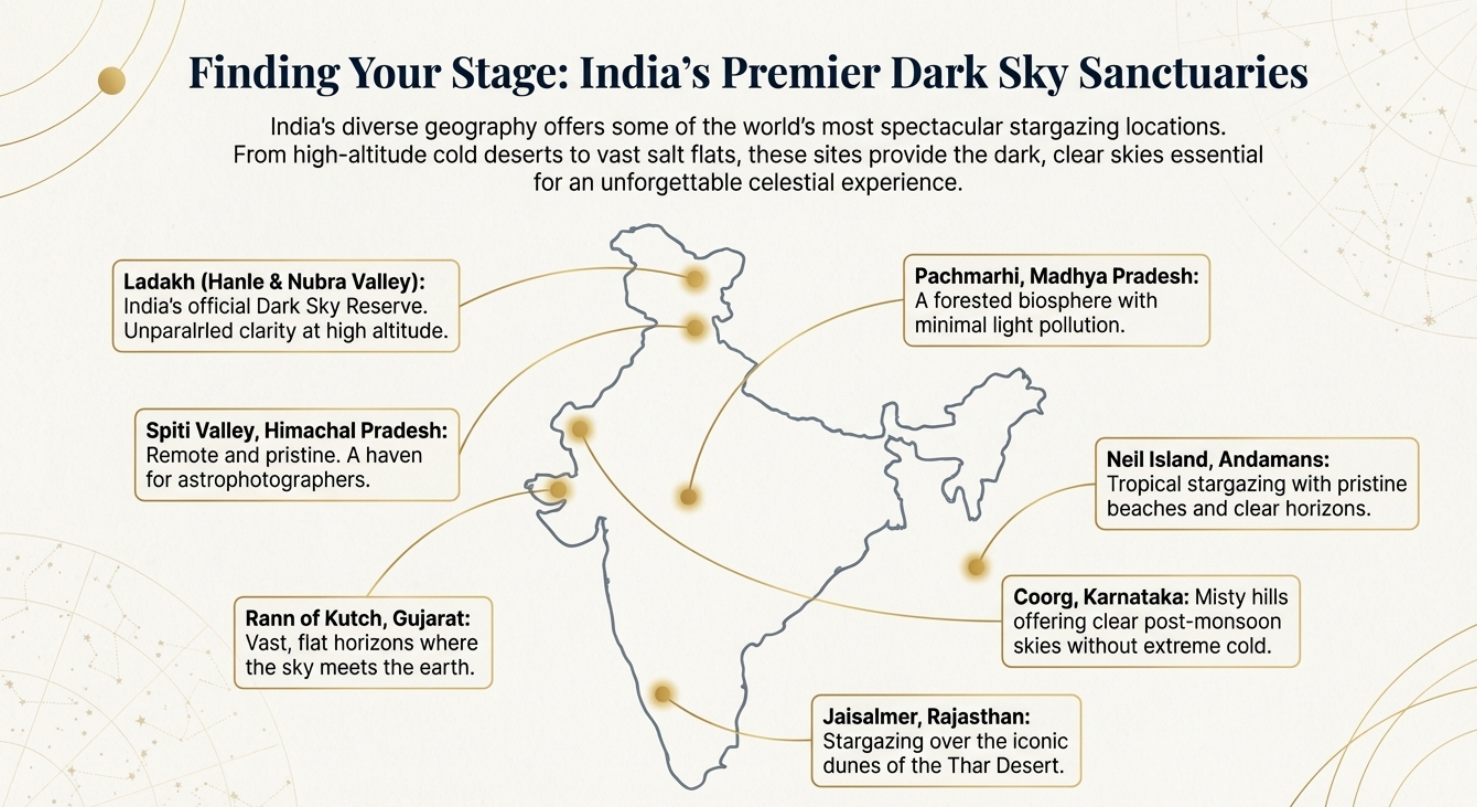
- Rann of Kutch, Gujarat – Wide open skylines and dry air.
- Hanle & Nubra (Ladakh) – Among India’s darkest skies (for those who can tolerate the cold and altitude).
- Spiti Valley, Himachal Pradesh – Clear, cold, and high.
- Pachmarhi (Madhya Pradesh) – Forest-protected skies with lower light pollution.
- Rural Deccan & central India – Away from city clusters like Hyderabad, Pune, Nagpur.
How to Observe
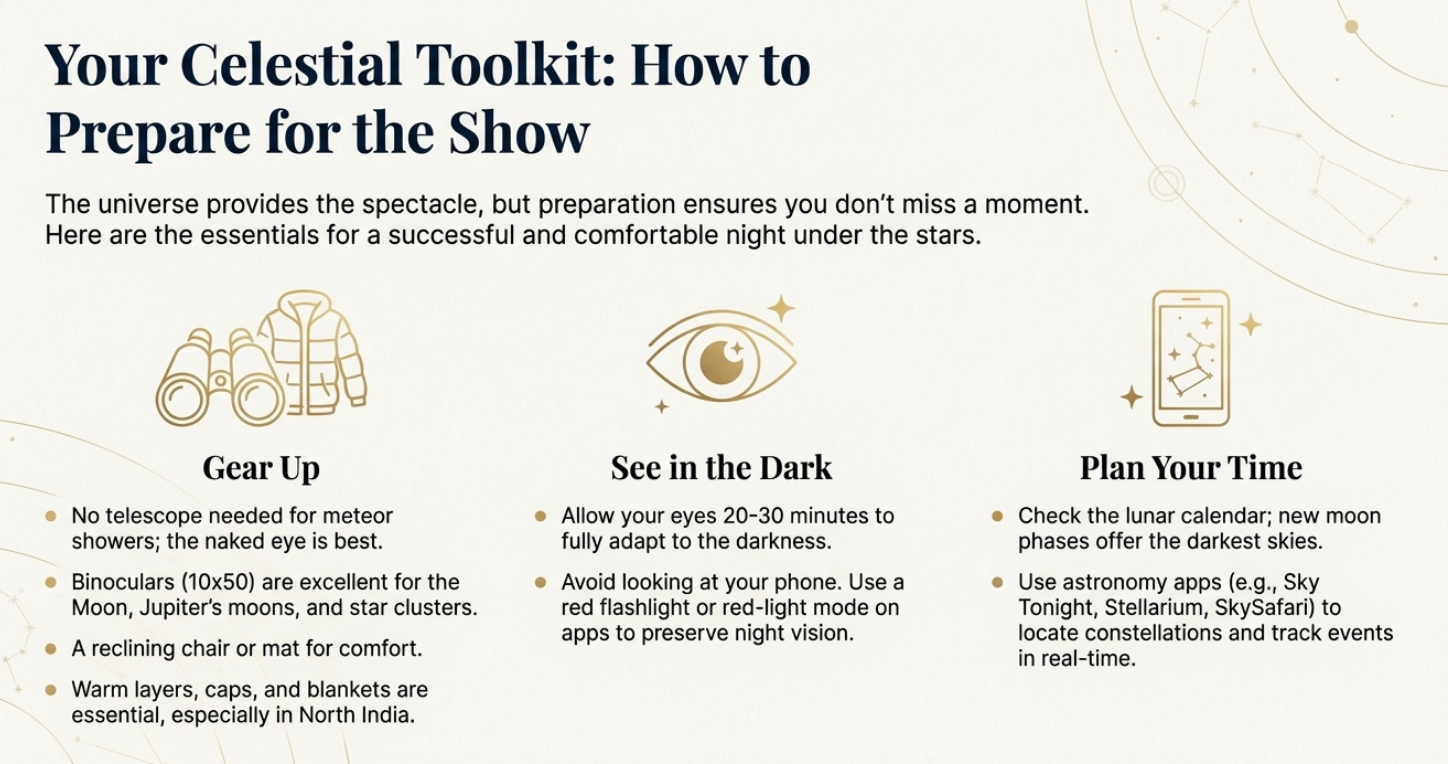
- No telescope needed—naked-eye viewing is best.
- Lie flat on a charpai, mat, or reclining chair, and look up at about 45–60° altitude away from the radiant for the best spread of meteors.
- Allow at least 20–30 minutes for your eyes to adapt to the dark.
- Avoid bright phone screens; use red screen/night mode if using star apps.
3. December Solstice & Ursid Meteor Shower – 21–22 December 2025
Winter Solstice – 21 December 2025
The December solstice marks the start of astronomical winter in the Northern Hemisphere and brings the longest night of the year for India. In 2025, it occurs on 21 December at 15:03 UTC (around 8:33 PM IST).
For Indian skywatchers, this means:
- Longer, darker evenings—great for deep-sky observing and meteor watching.
- An excellent time for family stargazing sessions under cool, clear skies, especially in north and central India.
While Uttarayana (the Sun’s northward journey) is traditionally observed around Makar Sankranti in mid-January, the astronomical winter solstice is its scientific counterpart—an ideal moment to talk about Earth’s tilt (23.5°) and seasons.
Ursid Meteor Shower – 21–22 December 2025
The Ursids are a minor meteor shower, but 2025 offers excellent conditions.
- Active period: Around 17–24 December
- Peak night: 21–22 December 2025 (best seen late night of 21st through pre-dawn of 22nd)
- Typical rate: About 5–10 meteors per hour under very dark skies.
- Moon phase: Only about 3% illuminated—almost new moon, making the sky very dark.
- Radiant: Near Ursa Minor (Little Bear), not far from Polaris (Dhruva Tara), so this shower favors northern latitudes.
For observers in Kashmir, Himachal, Uttarakhand, northern Rajasthan, Punjab, Haryana, and Delhi NCR, Ursids can be a quiet but rewarding companion to the solstice night.
4. Planetary Delights – Jupiter & Mercury
Jupiter – King of the Evening Sky
By December 2025, Jupiter remains a brilliant evening object:
- Visible soon after sunset, high enough in the eastern to southern sky later at night.
- Shines at around magnitude -2 to -2.5, easily outshining most stars.
- Through even a small telescope or good binoculars (mounted), you can see:
- Its four Galilean moons
- Hints of cloud bands on the disk
In Indian mythology, Brihaspati (Jupiter) is Guru, the wise teacher—a nice cultural touch when introducing children to this bright “star” in the sky.
Mercury – A Subtle Morning Visitor
Mercury often plays hide and seek, but December typically offers at least one good morning apparition:
- Around early to mid-December, it appears low in the eastern sky shortly before sunrise, shining as a small, bright point.
- To see it:
- Find a clear, unobstructed eastern horizon.
- Look about 30–45 minutes before sunrise.
Pair this with a thin crescent Moon if dates coincide, and you have a beautiful pre-dawn tableau over places like coastal Gujarat, Maharashtra’s Konkan, or Tamil Nadu’s seashores.
5. Best Practices for December Stargazing in India
Weather & Conditions
December is one of the best months for astronomy in India:
- North & West India (Delhi, Rajasthan, Gujarat, Ladakh):
- Cool to very cold nights
- Often clear, dry air—excellent transparency
- Central India (Madhya Pradesh, Chhattisgarh, Vidarbha):
- Pleasant nights, moderate humidity
- South India & Coasts:
- Some post-monsoon humidity and occasional clouds, but many clear nights too
Always check the local weather forecast and cloud cover using apps or IMD updates before planning serious night-long sessions.
What You Need
You don’t need expensive gear to enjoy December’s sky:
- For Meteors:
- A mat, reclining chair, or charpai
- Warm clothes, cap, socks, and maybe a blanket in north India
- A thermos of tea or coffee
- For the Moon & Planets:
- A pair of 10x50 binoculars is enough to enjoy craters, Jupiter’s moons, and bright star clusters
- For Photography:
- A tripod, DSLR or mirrorless camera, wide-angle lens (14–24 mm) for meteor showers
- For Moon close-ups, a 200–300 mm lens works well
Light Pollution & Safety
- Try to move away from city light domes—even a 20–30 km drive from a big city can dramatically improve the view.
- For late-night trips, go in groups, inform someone at home, and prioritize locations that are safe and familiar.
6. Where to Go – Indian Stargazing Hotspots
India offers some of the most diverse stargazing locations in the world. A few excellent December options:
- Hanle Dark Sky Reserve (Ladakh) – Among the darkest skies in India; ideal (for those who can handle altitude and cold) for Geminids and deep-sky views.
- Spiti & Kinnaur (Himachal Pradesh) – High, dry, and sparsely populated; great for both Geminids and the Ursids.
- Rann of Kutch (Gujarat) – Wide horizons and minimal light pollution; a natural stage for Geminid meteors and the Cold Supermoon over the salt desert.
- Jaisalmer & Thar Desert (Rajasthan) – Sand dunes, clear horizons, and stunning full-moon landscapes.
- Pachmarhi & other central Indian plateaus – Balanced access, dark skies, and pleasant December climate.
For many readers of StarGazing India, even a village on the outskirts of Bhuj, Jaipur, Bhopal, Nagpur, Coimbatore, or Guwahati can become a fantastic natural observatory if streetlights are minimal.
7. Bringing It All Together
December 2025 is more than just the last page of the calendar—it is a cosmic finale:
- A supermoon that bathes our landscapes in silver light,
- The Geminids, writing fiery lines across the sky,
- The solstice, reminding us of Earth’s tilt and our place in the solar system,
- The Ursids, a quiet meteor drumbeat near the pole star,
- And the constant, reassuring glow of Jupiter, our evening guardian.
For us at StarGazing India, these events are invitations—to step outside, to bring children and elders under the same sky, to merge Indian cultural stories of Chandra, Brihaspati, and Dhruva with modern astronomy, and to nurture scientific curiosity with wonder.
So as December arrives, pack a shawl, a flask, and your curiosity. Look up, breathe in the cold air, and let the night sky over India tell its timeless story—one star, one meteor, and one moonrise at a time.